Brief history of The Brousse and its church, referred as Sainte-Foy
“The place is called “La Brousse”, “The Bush”.
Its church and its priory, called “Domus de Broscia,” belonged to the Order of Saint Anthony the Viennois, or Antonines, founded between 1093 and 1095 by a Dauphiné lord, Gaston, to care for those afflicted with Saint Anthony's Fire. It was solemnly approved under Urban II at the Council of Clermont-Ferrand, in the centre of France. These Antonines wore the azure Tau cross on their garments. They engraved this beautiful sacred symbol, a crutch, cane, or “Croce,” extensively on the walls of La Brousse.
The priory had been under the patronage of the lord of La Hote-Carnilhac since 1420. In addition to the information provided by Abbot Muller, a few other details can be added: La Brousse is mentioned in the cartulary of Brioude. There is a charter, number 300, approximately dated 1011, in which Abbot Erudus establishes his manor at La Brousse.” “Villa” “Villa Brocia”. Later, in 1415, La Brousse is mentioned in the accounts of Bertrand Sanadre, receiver of 634 parishes in the Pays Bas d’Auvergne, for the sum of 12 écus.
A document from 1462 mentions “the house and brotherhood of Sainte-Foy of La Brousse”. This expression would be used again just a few years before the Revolution, referring to the “rural and secular priory of the brotherhood of Sainte-Foy of La Brousse”.
According to Paul Le Blanc, La Brousse and its church were destroyed during the English invasion, and Sainte-Foy was rebuilt in the 15th century. It served as the parish church for the villages of Lupiat, Lentre-Jeune, and Lentre-Vieux. It also became the seat of a priory dependent on the Viscounty of Lamothe, as stated in E. Muller’s document.
At the time of the Revolution, the church of Sainte-Foy was deconsecrated: Its last priest, Guillaume Louis Bertrand, who had been in office since November 1779, retracted his appointment and became the priest of Lamothe.
The commune of La Brousse was abolished on June 4, 1845, and annexed to that of Chaniat.
Since 1888, a number of modifications have been made to the church. Windows and corbels, and especially the Roman entrance gate, were reportedly sold by its owner to an antique dealer.
In more recent times, the church of Sainte-Foy was under the patronage of the Bishop of Saint-Flour.
The story is that of the peasants who see the land of La Brousse as an advantage and its buildings as a liability. They redraw the land registry and sell the buildings alone; today, only the church, the bread oven, the small barn, and the sheepfold remain.
The property becomes that of René Jourjon, an “Antique dealer and Free spirit” by profession. The floor of the sheepfold, which we use as a dwelling, is made of clay/dirt. One window. There is no water or electricity. It's 1982, and while telephones and colour television are arriving in households, we leave for La Brousse on weekends, laden with water and wood.
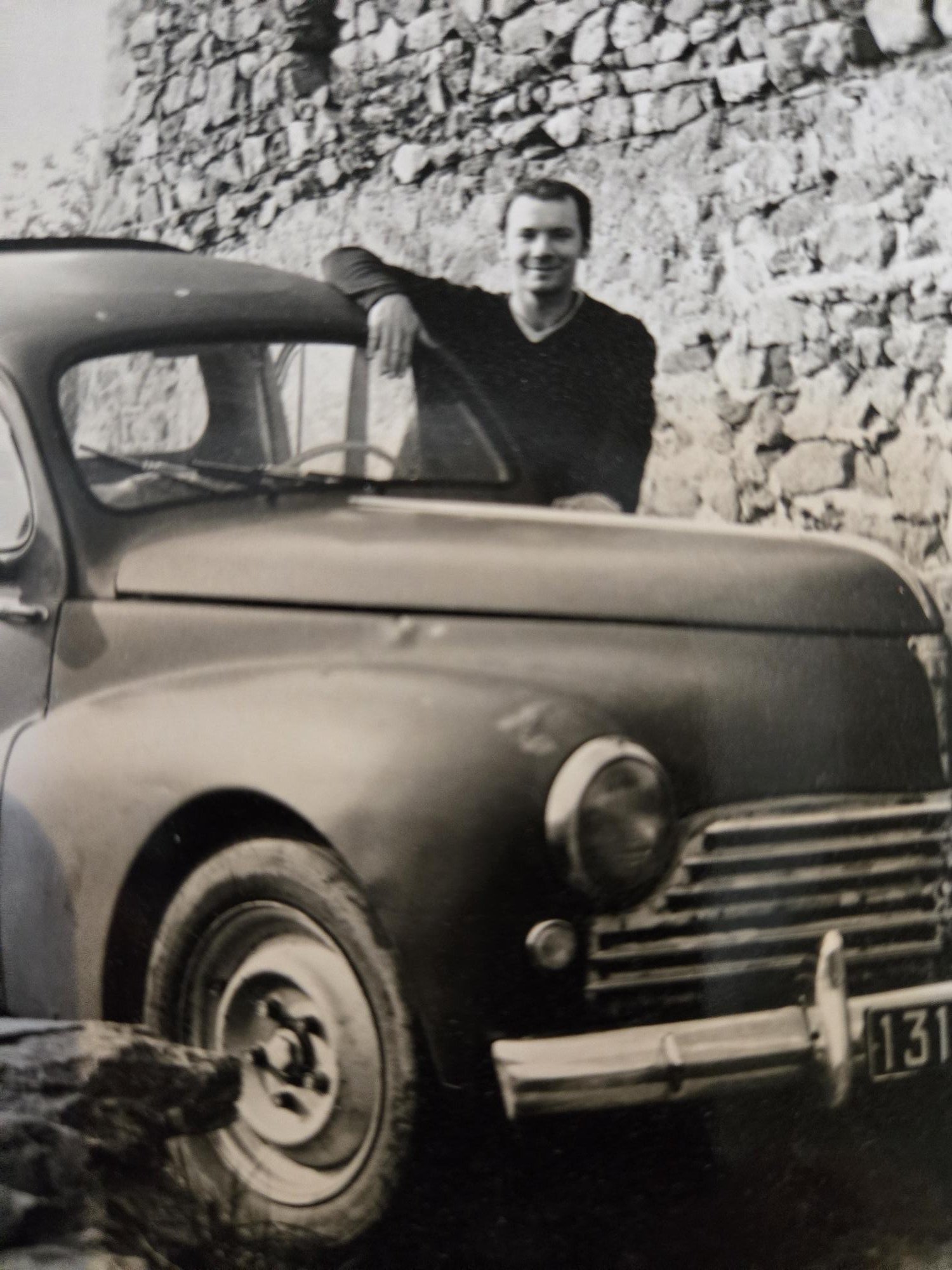
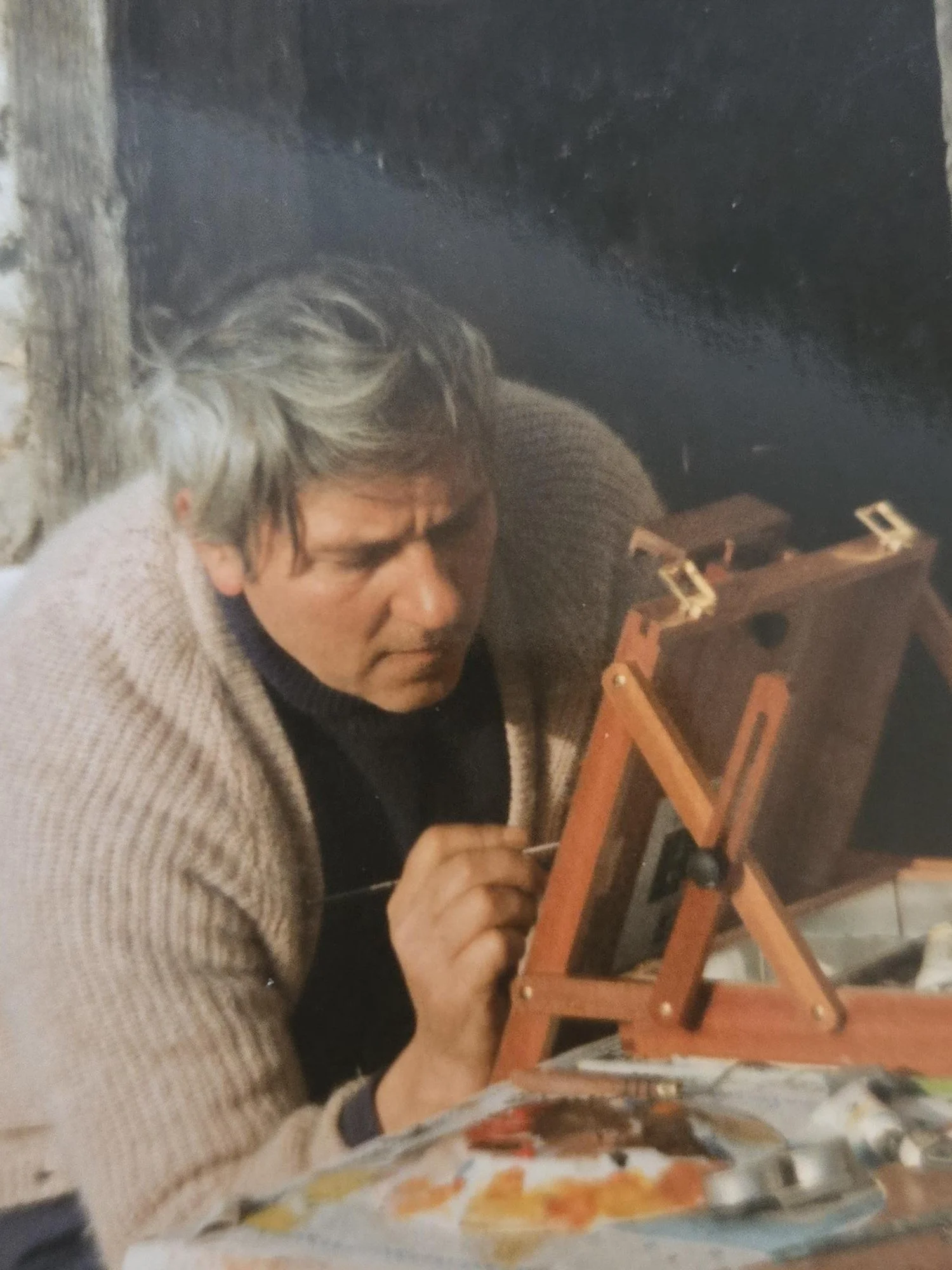
René leaves in 1992, shy of his 50th birthday, after declaring that his greatest achievement was bringing water to the place. I think his finest creation is displayed on the chancel wall of the church, where he drew a large-scale portrait of the Angel Gabriel. He also took care to have the church listed as a listed building in 1986.
We are three siblings; we are twenty years old. Ivy is taking over the church. The vegetation blocks the access to the sheepfold. The bread oven is losing its roof...
A few years later, my brother returns to the place, tentatively at first, then regularly. He makes his task to covering the broken tiles and the roofs with stones and plastic sheets, just as he had seen his father do. Essentially, a Herculean job, almost weekly.
In 2011, we dissolved the joint ownership. I became the sole owner of the church, to which I dedicate, with my husband's support, a beautiful restoration project.
My brother passed away in 2012, and with him, he took the roofs and timber frames of the sheepfold and barn, the lawnmower, the small generator, and my restoration project. In exchange, the church gains new inhabitants, mainly algae and vegetation of all sorts.
In 2014, still reeling from the double loss of my brother and the cancellation of my restoration project for the beautiful church, and because reason prevails, we decide as a family to acquire the barn and the sheepfold and rebuild the latter.
In 2018, fuelled by my enthusiasm for the building work and the many French administrative forms (I laugh as I write it) and the determination to save the church, which remains the main goal, I reopen the discussions, get out a calculator, and look for an architect, which brings us back once again to the Church of Sainte-Foy. In 2020, we finally obtain the title deeds for plot E60 on the land registry, which separates the sheepfold from the church, which until then had been landlocked.
We are in the midst of the Covid crisis.
Today, 2026, the Church of Sainte-Foy at La Brousse still stands; in peril, certainly, but the walls and roof are still there. Isn't that simply wonderful?!